Showing posts with label A-Z. Show all posts

Wednesday, October 10, 2007

X Prize

So, how many of you have heard of this? The X Prize.

Back when I wrote the A-Z series, it was my back up plan for the letter X. Currently, it doesn't have much relevance to real estate, but one day it might.

The original X Prize was $10,000,000 to be awarded to the first entrant to launch a craft in to space, and then turn around and do it again with the same craft within a short period of time. Another current X Prize is for Genomics.

The X Prize that grabbed my attention is the Automotive X Prize. The basics involve developing a car that is capable of at least 100mpg, can carry 4 people, and emit under a certain amount of pollution... and it has to be marketable to real people. No carbon fiber, $1M concept cars that look like a cross between a VW Bus and a bar of soap. Think about something more like an accord that has some evolved technology and can be sold for under $30k. I've even decided how I think it might be possible...

"But, this relates to real estate how?"

I'd love to see an X Prize that involved low cost building designs for developing countries. Of course, I'd like to see this developed in a manner that it could positively impact local economies, providing jobs and profits...

Just a thought... and this isn't what I would do with the money.

Friday, September 21, 2007

Z is for ...

Z06 Corvette, Nissan 240Z, Z28 (1LE!), Zamboni, Zagato, Zonda, some other fabulous car beginning with Z....

No.

Zillow. I mean really, this is a real estate blog. How could I go through the alphabet and not hit Zillow for Z? If you don't know what Zillow is, go ahead and Google it... we'll wait...

Got it, ok.

There is a whole language that has sprung up around Zillow. The valuations that they provide are called Zestimates. But, most interesting is the use of the word zillow and zestimate as verbs... comically.

Zestimate: to provide a wildly inaccurate valuation. "The zestimates for the neighborhood were all over the map, with some being $20,000 high, and others being $50,000 too low."

Zillow: to price a house too low. "That poor guy got zillowed when he sold the house for $400,000. The buyer sold it a year later for $500,000."

Truthfully, I can't speak to the accuracy of the valuations from Zillow. They don't seem to have much data here in the sticks of Atlanta. I will say that the house next door to me sold for $10,000 above the Zestimate in just a couple of days on the market this summer.

Lane... what's the point?

The point is that the internet is a wonderful tool. There are great websites that can be used to find all sorts of information. Information is a tool. Craftsmen (and Craftswomen) are the ones that know how to use the tools. Just because someone can buy a TIG welder doesn't mean that they are a TIG Weldor (despite Mozilla giving me a spelling error, a Weldor is a person that welds... according to the welder manufacturers).

So ends my A-Z journey. It's been fun, and I might take it on again with slightly different focus. Now I can get to the list of 15 posts or so that I have thought up while writing these...

Thursday, September 20, 2007

Y is for Youth

Welcome to the home stretch... and I do mean streeeetch.

If you've been following along, you know that I have been running a series of posts going from A-Z. I am almost done, even though I don't know what Z is going to be yet...

It's Y time!

Youth... and real estate... how am I going to tie them together?

OK, I got it.

Again, anyone that has followed along knows that I am a car guy. Well, here's a shocker, I'm a NASCAR fan as well. While I'm not really a Michael Waltrip fan, he did something back during the week leading up to the Daytona 500 that gave me a lot of respect for him. (I can hear you asking yourself where youth and real estate are going to work their way into this little story)

As any race fan knows, teams look at rules differently that the rest of us. We see rules, and we look for ways to comply. They see rules, and they look for loopholes. The object isn't to cheat, but rather to exploit the weaknesses in the rules. I have a little bit of racer in me, too. However, I don't have the same type of risk that the racers have. If I really stretch out here, I might point out that any lawyer with a contract in front of him is thinking the same way a crew chief is with a rule book... but I digress.

Back during the 2007 Daytona 500, Michael Waltrip's crew chief pushed several rules too far. He lost points, he lost money, and he lost competitiveness. But, he lost something else. At a news conference, he was asked about his infraction, and how it would impact the future of his team for the season, as well as how it impacted him. Keep in mind that all of the teams view the holes they find in the rules to be where competitive advantage lives.

Michael Waltrip explained that when he got home, he had to explain to his young daughter what happened. Garrett at deskShe looked at him point blank (and he said she had tears in her eyes) and asked him, "Daddy, are you a cheater?" He started to tear up a little as he related the story. (maybe I'm a sucker, but I bought it) Keep in mind that MW isn't just a driver that shows up and drives the car, he owns the team. If the team is cheating, he's a cheater. He had to tell his little girl that he was a cheater, that he got caught, and that it was wrong.

I don't know about anyone else, but I think that might be a harsher punishment than a $50,000 fine.

So, I'm almost to the part where I tie this up in a neat little package.

In the eyes of a child, there is right and there is wrong. Kids don't deal in gray. If you break the rules, you're a cheater.

What about in real estate? Can we stand up to the scrutiny of a kid? When we deal with our clients, our customers, our vendors, do we deal as honestly as we can? Do we disclose the problems we find? Do we tell our clients that they need to stop looking for a way to game the system, and take the lumps? Do we deal with all parties honestly?

Forget about agency rules. Forget about the NAR Code of Ethics. Forget about HUD law. Think about your kids. Are your's the actions that you expect from your kids? More importantly, are they the actions of which your kids would be proud?

I know that my dad did things in his life of which he would not approve had I done them. However, I also know that on balance he led a life that he would approve of had it been mine. I hope that I am able to offer as good of an example for my son.

Wednesday, September 19, 2007

X is for Xenophobia

I think I was at E when I figured out what the subject of this post would be. As I was writing about ethics, I knew that I would just have to do this post. However, I'm going to stretch the definition to fit my needs.

Simply put, xenophobia is the fear of foreigners, or more commonly, the fear of those that are different. Despite the etymology of the word pointing more towards birthplace or culture, I will be using the looser definition.

Like Garth in Wayne's World, as he was speaking to Rob Lowe's character after the basement show goes big time, I think that we all fear change to some degree. As a great example of this, take a look (or better yet a listen) around you. People reach a point where they simply stop dealing with change as easily as they had previously. Not all, but many seem to hit that point in their senior year in high school. People that graduated in 1973 will think that good music largely stopped then. The same for 1983, 1993 or 2003. Or even 1923. At some point later, hair seems to get stuck in the timewarp next to the music collection (I don't mean losing it, I mean not wanting to change it)... clothes, too. I still hate wide ties, and my Dad could never understand narrow ones.

OK, I hate all ties, so nevermind.

Left turn, and back off my tangent...

Many, if not most people fear change. Looking at it more deeply, we fear that with which we aren't familiar. Personally, I think that is the basis of xenophobia. But, like the fear of sashimi, there is something to be learned by overcoming that fear. I think that what we can learn is that there isn't anything to fear. Those we fear are pretty much like us. They might look different, eat differently, or even love differently... but so do we when looked at through their eyes.

"But Lane, how does this apply to real estate?"

I promise that I had this coming a LONG time before this, but just today, Eric Kodner and Charles McDonald had GREAT posts (with excellent comments as well) about Fair Housing and the practice of real estate. The "X word" even showed up in the comments.

The point for real estate agents is that we CAN'T be xenophobic. Furthermore, we can't let our sellers be xenophobic. And, if our buyers are xenophobic, we can't let that influence the way WE do business. Xenophobia, bigotry, racism and prejudice aren't illegal (long comments about that...) but that doesn't mean they are ethical. And, acting upon those beliefs or fears CAN be illegal, as well as unethical or immoral.

But, getting past xenophobia CAN be fattening. Think of the amazing foods. Beef Momo from Tibet is amazing. Nigiri Maguro (tuna on rice sushi) with a hint of wasabi is great with saki. And, don't forget a rib sandwich on white bread from Fat Matt's Rib shack on Piedmont Avenue in Atlanta (go at night, catch live blues). Skip lutefisk... lye is NOT a seasoning.

Keep it real.

Tuesday, September 18, 2007

W is for Win... and Win

One of my favorite things about residential real estate is that everyone can win. Think about it. We have a seller. The house is generally no longer serving their needs. Maybe they are leaving the area because of a new ob, a transfer or retirement. They might be having a new child, kids moving off to college, or moving up to a new house because of a promotion.

I know, sometimes people are moving because they can't afford the house, or they got laid off. Companies move, and people don't want to, but have to. But, I've found that most of the sellers I've dealt with are happy to be moving. Most have enjoyed being in their home, but are ready to begin in a new place, and genuinely excited.

Next up, we have a buyer. Maybe they are transferring, or having a new child, or shipping one off. They might be retiring, or celebrating a big promotion. But, it's all of the same stuff that motivates people to sell, and like sellers, most are excited and ready to begin a new stage in their lives.

Then comes the offer, inspection and negotiation. We have closings and loan applications and second thoughts. This is where the trouble lives, deep in the shadowy liar of other stuff that needs to be done.

Usually, when the buyers send over an offer that the seller accepts, everybody is happy. Then, something occasionally infects someone. Inspection negotiations, or some last minute surprise pushes out the trouble monster. He tries to turn the win/win into a win/lose. That is the point a good agent needs to step in and try to tame the trouble monster.

This isn't tennis or football. Real estate is not a hockey game. In order for there to be a winner, there does not have to be a loser. Everyone in the transaction CAN get what they want. And don't forget, Karma is a witch. If one feels the need to make the other party in a real estate transaction a loser, someday, it will happen to you... and Karma also loves a pile on. Even in the same transaction, beating up the buyer or seller over the inspection might mean that the seller or the buyer beats back before closing... or even not closing. Then we have the worst outcome. Lose/lose.

I don't need bad Karma.

Monday, September 17, 2007

V is for Virtual

I think that this might be the most over-used word in our lexicon. We live in a world of Virtuals.

  • Virtual Assistants
  • Virtual Tours
  • Virtual Stores
  • Virtual Meetings
  • Virtual Offices

And my very favorite...

  • Virtual Real Estate

Yes kids, there is "virtual" "real" estate. Second Life offers people the opportunity to "own" real estate in a virtual world. Real companies are spending real money to get virtual customers. >as an aside, can virtual companies spend virtual money and get real customers?<>

Back to the subject... where was I?... Oh yeah, Virtual.

We are in the world of real estate. What place does virtual play in our world of real? Actually, despite virtual and real being antonyms, they seem to belong together. As I write this, I'm in my virtual office. I attend virtual meetings on a pretty regular basis. I don't have a virtual assistant, but I am looking at farming out work to one... and my wife is actually a virtual assistant for several lawyers. I have shopped virtual stores (for real stuff).

And, I don't think a listing has a place on the market unless it has a virtual tour. Virtual tours appeal to real buyers. I know that I have said it a bunch of times, and I bet every real estate agent you know has told you, 85% of buyers start their search online. Those are real buyers. A virtual tour will never replace a real tour, but if there isn't a good virtual one (and a lack of a virtual tour is not a good virtual tour) there may not be a real one at all.

It is a real part of a real strategy to sell a real home.

Sunday, September 16, 2007

U is for Ultimate

Walker DriveUltimate. There is a loaded word. For me, it brings to mind a 3,000 square foot garage with high performance floor coatings, a pair of lifts, a dedicated welding bay, loads of tool storage, a kicking HVAC system, and compressed air available in each work space. Of course, there would be a trolley system to move heavy junk (I like heavy junk), and workbenches that could handle the weight of Dana 60 axles and engines.

For someone else, ultimate might mean a darkroom in the basement with a 12 foot sink, and the capability of printing 4x5 negatives to 20x24 prints. Of course there would also be great ventilation and a sound system to let the user jam out while printing.

For our third person, ultimate might mean a play area in the yard that would make both McDonalds and the local county park jealous. There would be a pirate ship and a space ship. Swings, slides and an obstacle course would just have to be there. Commercial stove

Maybe ultimate could be a master bath worthy of a fine spa. Imagine relaxing in the jetted tub with soft music and filtered light. Candles providing a warm atmosphere and wonderful aroma.

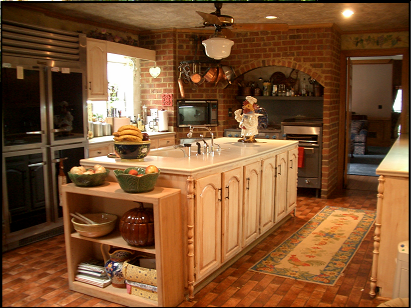
Ultimate could also mean a commercial worthy kitchen. High performance refrigeration that keeps temperatures steady with but a single degree of variance, six burner stove and double ovens. Maybe it means a dedicated griddle on the stove for eggs and pancakes in the morning. Granite, stainless steel or even concrete counter tops might also be in the picture.

For yet another person, ultimate might mean a media room that makes all of your friends want you to have a movie night on Saturday, and a football afternoon on Sunday. A wall of video, and a virtual wall of surround sound. More definition that Webster, and recliner for every viewer might be part of that ultimate package.

What is the point of all of these descriptions? I would guess that almost every reader has a slightly different take on "Ultimate" to meet their personal needs. I have one view, my wife another, and my three year old son would have yet another. An Ultimate House will be even more personal than your favorite place to eat.

I'd love to hear about YOUR ultimate house. What makes it the supreme place for you to be (or want to be)? And, when you decide you need to find that ultimate house, let me know. We'll find it for you.

Saturday, September 15, 2007

T is for Technology

Talk about a can of worms...

As an agent, there are so many types of technology, and so many options within those types that it can be overwhelming. Every day, I get dozens of emails offering me the exact new technology that is going to make buyers and sellers step all over each other to do business with me and nobody else. Some are quite intriguing, other... not so much. Whether it is broadcast html email, radio broadcasts, lights for my listing signs, listing sheets sent via text message to phones, listing enhancements for popular websites, or search engine optimization, I know that some company is going to send me the latest and greatest new solution... even if I don't know what the problem is yet.

For a buyer or a seller, the problem is similar, but luckily not as severe... especially for buyers.

Buyers are mainly bombarded by websites offering listings. Not only are there the heavyweights, like Realtor.com, or Century21.com, but every agent and brokerage (ok, most agents and brokerages) also offer all of the listings from the local MLS. Of course, let's not forget that there are dozens of sites that list the homes that are not listed by real estate agents. Too bad all of the FSBO sites can't get their act together and put all of their listings in one place. Oh yeah, then there are the classified sites, like Craigslist or the local newspaper. There are specialty sites, ranging from Ebay to Hemmings Motor News to Autoweek. For sellers, there are huge questions about where to really look to find the best deals, or at least to find a great agent to work with.

Sellers have many of those same outlets staring at them. Of course, if they get an agent, then the agent is usually handling the advertising media. But, while selecting an agent, the agent's advertising starts to come into play. Not only does a seller need to have a clue about where the agent is advertising their listings, but also other technologies the agent might use. Among some of the technologies that a typical seller will run across are sign lights, postcards (just listed cards, or even mailers to apartments), talking house systems, individual web pages or sites, and text message flyers.

As an agent, I get to look into ALL of those sites, technologies and systems. Of course, it's my job. But, I also get to look into a bunch of different options for promoting myself. There are so many options it is dizzying. Some are time proven, and continue to perform. Others are promising insights into future technology. Some are interesting, but I would say "lack the dignity a professional should require. Some are just stupid.

In no particular order...

  • Blogging
  • Websites (and along with that, the myriad of providers, SEO, pay per click, domain strategies, etc.)
  • Podcasting
  • Listing lights for signs
  • Special riders
  • Telephone tracking through 800 numbers
  • Recorded info systems
  • Radio broadcast systems from the home
  • Different media advertising (newspaper, radio, TV, magazines, etc.)
  • Text flyers to phones
  • Listing site enhancements (like Realtor.com showcase listings or enhanced listings)
  • Brochures
  • Flyers
  • Logos
  • Personal advertising campaigns
  • Broadcast email
  • Email property flyers to agents

OK, I'm getting tired, and I haven't even gone back and looked at old or discarded mails to see what I might have missed.

Here is something from the "hmm, I don't think so..." category. Link.

Stupid wheelsI'm a car guy, but I don't think I'm putting a set of those on my ride...

Friday, September 14, 2007

S is for Staging

***I'm proud to have a guest host for today. Angel Walker is a professional stager here in the Atlanta area. Here is a quick bio about Angel.

Angel Walker is an Accredited Staging Professional Master™ and the owner of Staging Professionals, LLC. Angel received her training directly from Barb Schwarz, the CEO of Stagedhomes.com. Prior to founding Staging Professionals, LLC, Angel had over 10 years experience in corporate marketing. Angel specializes in Staging occupied homes
in North Atlanta. www.stagingprofessional.com

S is for Staging

There has been a ton of buzz around Staging in recent months. It has been great to see the word getting out about the value Staging can bring to the residential real estate market.

Why Stage?

There is over 9 months of inventory on the market right now. With so much to choose from, Sellers have to do everything they can to make their house stand out among the crowd. Statistics tell us more and more Buyers are shopping online for their next home. Staging prior to listing improves the pictures posted online and creates an inviting feeling for Buyers who view the home in person.

If you were selling your car tomorrow, you would probably get it detailed. When we Stage, we detail the house like you would detail your car. Where is your equity?

There are several myths about Staging, and I would like to dispel a few of them.

Myth #1: Staging is decorating.

Staging is actually the opposite of decorating. Stagers de-personalize a property so that a Buyer can make their own connection to the home. There have been times when I felt like I’d known the Sellers for years after viewing their home. That is not the impression a Seller wants to make upon a Buyer. The goal is to get a Buyer excited about creating their own memories in the house, not reliving someone else’s.

Myth #2: Staging is expensive.

Stagers can work with just about any budget. Sellers have to determine how much time and effort they can put into preparing their home for sale. If money is tight, hire a Stager for a Consultation. This gives Sellers a roadmap of recommendations they can implement themselves.

To make the most impact in the shortest amount of time, hiring a Stager to do the work is the way to go. Many Stagers work in teams. The combined creativity of several professionals trained and motivated to Stage cannot be put into a Consultation. Every time I’ve worked on a Hands-On Staging project, I’ve been blown away by the transformation. The feeling of the property changes. It’s hard to describe in words, but it is what I love most about this industry.

Every Stager sets their own pricing. Find a few Stagers in your area and contact them directly to get a feel for how they work and how they price their services.

Myth #3: I’ll just take down my family photos.

Stagers look at the entire house, up and down, inside and out. If it is included in the sale, the Stager is looking at it. Are the light fixtures full of cobwebs? Is the carpet worn and stained? Is the bathroom too dated for the price range? How does the furniture flow? Stagers point out recommendations to improve the property so that it compares favorably to the competition. The recommendations are prioritized so the Seller can decide what they are comfortable doing within their budget and time frame.

Why hire a Stager?

We love what we do and we bring passion and creativity into every client’s home to assist them in achieving their goal of selling as quickly as possible for the most money.

Angel Walker
Accredited Staging Professional Master
Staging Professionals, LLC
Specializing in Staging Occupied Homes in North Atlanta
www.stagingprofessional.com

Thursday, September 13, 2007

R is for REALTOR(R)

I know I'm being picky, but this needs to be said.

All REALTORS(R) are real estate agents, but all real estate agents aren't REALTORS(R).

One becomes a real estate agent by passing a test. One becomes a REALTOR(R) by joining the National Association of REALTORS(R). In order to join the NAR, a REALTOR(R) must attend special ethics training, and agree to abide by the NAR Code of Ethics. As a consumer, if interested in what this means, feel free to look at the NAR website for more info.

Not only are all real estate agents not affiliated with the NAR, according to the NAR, only about half are. And yet, the very vendors we deal with, as well as consumer experts (like Clark Howard) use the terms REALTOR(R) and real estate agent interchangeably. I'm just picky, personally. However, I have been through the NAR ethics training, and I feel that it is my duty to deal with ALL others in a transaction in an ethical manner. I pay my dues (one reason that many choose not to join).

To be sure, I want to state for the record that there are MANY fine real estate agents that are NOT members of the NAR. Their personal ethics are as good as any member of the NAR. There are also REALTORS(R) that are far less ethical than the NAR Code of Ethics require. (At this point I would like to say that any consumer should get to know their real estate agent, whether they are a member of the NAR or not, and make sure that their agent is really working on their behalf). A big advantage of working with a REALTOR(R) is that there is an extra layer of accountability. Not only am I accountable to the the state real estate commission, but I am also accountable to the local and state associations.

I am a member of the DeKalb Association of REALTORS(R), as well as the Georgia Association of REALTORS(R), and the NAR (it's a package deal, really).

Wednesday, September 12, 2007

Q is for Quit Claim

Let me preface this by stating I am NOT a lawyer, I don't play one on TV, and I don't dispense legal advice. If you need specific legal advice, you need to talk to a lawyer, not a real estate agent.

A Quit Claim Deed is kind of an anomaly in the world of deeds. Other deed transfers convey ownership of something to someone else. When propert is conveted with a General Warranty Deed, Executor's Deed, Foreclosure Deed, or Special Warranty Deed, these say that a person that has control and the capability to sell a property.

But, with a Quit Claim Deed, the Grantor may not actually have control of the property, or the ability to convey the property. But, that isn't what a Quit Claim Deed is for.

What it does is clear "clouds" that may be on the title. Let's look at a couple of scenarios.

CJ buys a house. Later, CJ meets and marries TJ. After several years of marriage, there are problems, and there is a divorce. After everything settles down, CJ wants to sell the house. TJ never owned it, and was never on the loan. The divorce attorney, or possibly even the real estate attorney might pursue TJ to sign a Quit Claim Deed to prove that TJ does not have an ownership interest in the property.

In the above example, the situation could have just as easily allowed TJ to have an ownership position in the property that they abandoned with the Quit Claim (assuming that CJ could maintain financing on the property).

Another example might involve a will. XJ leaves the house to one of the children, ZJ. The other children, WJ, YJ and JK might also be asked to sign Quit Claim Deeds to show that they do not have an ownership interest in the property.

Often, a Quit Claim is only brought into the picture if there is some sort of dispute. In other cases it is brought into the picture to prevent later dispute. The thing to keep in mind is that it doesn't convey property. It only shows that the Grantor has no ownership interest in the property. Finding a string of Quit Claims on a title search aren't necessarily a problem. Buyer's Title Insurance is almost ALWAYS a good idea, regardless of Quit Claims that show up on the search.

Tuesday, September 11, 2007

P is for Pictures

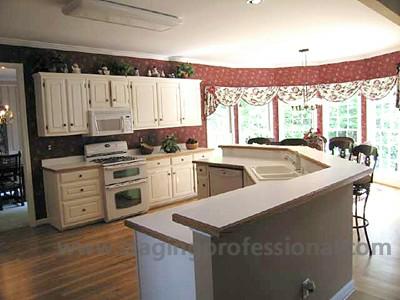
Cofer KitchenIf your listing doesn't have good pics, you'd better make it REALLY cheap. REALLY, REALLY cheap.

84% of buyers these days start their search online. They aren't looking for prose. They want pictures. They want lots of pictures and they want those pictures to be good. If there aren't good pictures from good angles that are lit in a manner to let them see the features they want to see, they move on.

Here in the Atlanta market, there are more than 100,000 homes for sale. Obviously these homes are in a variety of price ranges, and locations. They feature wide ranging levels of amenities and finishes. But, do you think there aren't any other homes competing with yours? If one house has great pictures of a beautiful house, and the next has a picture of the front, or even no picture (the horror!!), do you think that buyers are going to spend their valuable time investigating that house? Keep in mind that there ARE houses with excellent and plentiful pictures in their search as well.

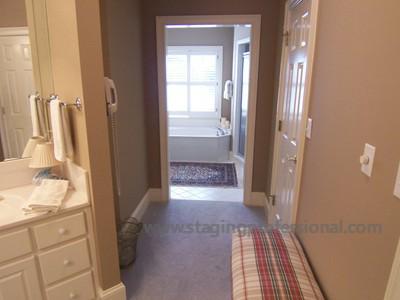
There are several steps that one should go through to insure the best possible result. Cofer Family Room

  • Talk to the agent that is going to list your home. Among the things you should talk with them about are staging and photographs.
  • Get a consultation from a home stager. You might need to spend some time removing wallpaper, painting, or doing other things to show your home in the best light.
  • Suck up your decorating ego. Staging for sale is not all about decorating. It is about showing the house in a manner that lets the buyer move in mentally. Homes that are too personal to the seller might be beautiful, but that doesn't mean they are staged to sell.
  • If you really hate what you were just told by the stager, get a second opinion.
  • Complete the needed work. In some cases, this might mean doing the work, in other cases this might mean hiring the stager to "set" the house.
  • Get pictures. If your agent isn't able to produce quality pictures, get them to bring in a photographer. The higher the price, the more willing your agent should be to bring in a professional photographer. There are some agents that will be able to make great shots, others are pretty challenged. Look at the pictures.
  • Make sure that your listing looks good on the MLS, as well as on realtor.com. Realtor.com is the most heavily trafficked real estate website, and only REALTORS(R) have access. I would also recommend that the listing be "enhanced", which is an extra service that your agent should have.
  • Keep the pictures reasonably updated. Snow in the summer, and spring flowers in the winter are clues that the listing has been sitting.
As with all things real estate, there are variations. But, it should be easy to get the idea. Make sure that YOUR house looks better on the internet than the house you are competing with. Those pictures ARE the first impression.

Monday, September 10, 2007

O is for Open House

There are two kinds of Open House events. One is for agents, and the other is for buyers.

The agent open house, which might also be referred to as a broker caravan, or simply caravan, is the more important of the two. It allows agents that work in the area to visit the house and see for themselves the condition of the property, and also see if it may meet the needs of any of their clients. One of the problems I have seen, especially as we have moved into a buyer's market, is the incentivization of the agent open house. I get emails almost every day touting drawings, grab bags and gas cards. "Prizes" range anywhere from a $10 gas card to a cruise.

From the perspective of a seller's agent, I would counsel a seller to consider not only having an agent open house, but also making sure there is some type of incentive to get agents out on a Tuesday or Wednesday (the common days for the caravan) and into the house.

From the perspective of an opinionated person, I think it is pretty sad that we have to offer prizes to get agents out to see the available properties and to help them better serve their clients.

Buyer open houses, which are the first ones most sellers think of, are actually less helpful for the seller. Having sat through my share of open house events, I will be glad to volunteer that the primary reason agents hold these events is to meet others and give out their card. I'm sure that there is an occasional sale that can be attributed to an open house, but the attendees generally fall into one of these categories:

  • The neighbor. Here is our most popular visitor. They have seen the house, and been curious what it looked like on the inside, or what changes the seller might have made since the last time they were able to get in.
  • The passer-by. It's a nice Sunday afternoon, and they are out for a ride... why not? There might be cookies.
  • The semi-pro open house visitor. There BETTER be cookies or something. These folks just like to visit houses and see what they have to offer (cookies, bottles of water, cake, hot dogs, etc.)
  • The dreamer. They might actually be in the market for a new home... but there is NO way they can buy this one.
  • The actual possible buyer. Yep, they are hiding in this group. They are looking for a house in this area and price range. They may or may not have an agent (if they are seriously looking, they have an agent, and will find the house regardless of the open house), but were in the area, and thought they might like to get in for a quick look.
  • The ne'er do well. I have to include this person, too. They are rare, but they are out there. Their goal visiting the property is to see if they can steal something now or later.

The dirty little secret is that there are two reasons agents agree to do buyer open houses. The first is because sellers demand it, thinking it will help sell their house. The second is that there ARE buyers to be had, just probably not for the house. To give you an idea about how slim the chances are in finding a real buyer, many agents actually "loan" out their open houses to new agents to allow them to build a database. You can bet if the agent doing the "loaning" thought there was real value in that database, they wouldn't be so eager to give it away.

In a seller's market, the landscape changes dramatically, and open houses are much more viable marketing. Right now, the best marketing is to have a house that shows well and is priced right. Make sure that area agents know about it, and make sure that the house is convenient for them to bring clients to visit.

Sunday, September 9, 2007

N is for Numbers

What are investors looking for?

What needs to add up for a first time buyer to get the first step in their dream?

What do we have to go through to find the right ones?

The numbers.

Investors look at the price, the carrying costs, and the potential cash flow. They pour over spreadsheets, or work their fingers to nubs on their financial calculators. The result is the no/no-go decision on the potential rental property.

First time buyers (and not so first time buyers) examine their budgets. They look over their savings (and their equity for those that have played the game previously), and try to figure out how much more they can scrape together before closing.

We send out cards, talk to people, and market to the numbers to find clients.

Everything about this business revolves around numbers. Telephone numbers, debt/income ratios, price, concession costs, and conversions factors. But, at the same time, I am told by other agents all of the time that they aren't "number people." Occasionally, I strike back with a "Look Sugar..." (remember, here in the south Sugar, Sweetheart and Honey don't have to carry a romantic connotation... or there are hundreds of Waffle House waitresses that are in love with me) "... you ARE a number person. You may be a people person, or a (?)letter person... but you are a number person, too."

Embrace your numberness.

Saturday, September 8, 2007

M is for Maintenance

Here is a loaded term for a car guy. Maintenance. We do it for our rides, and just about nothing can stand in the way. I've known guys that bordered on religious about changing their own oil. I've seen them pull into a rest area along the interstate, slide under the car and change their oil. A quick refill and clean-up, and they were on their way again. We would never think of leaving something undone.

Houses aren't much different. They need regular maintenance. They don't need oil changes, but they need those air filters changed pretty regularly. Painting, pressure washing, and caulking are all maintenance items to be checked off. There are scores of other things as well. Not only that, but one of the most efficient ways to keep a house up is to take care of anything that pops up. And to take care of it quickly and properly. When things are left undone, or poorly dealt with, the deeper the problems will become. Foreclosures and REO (bank owned properties) are usually the worst about maintenance. When people can't afford their house payment, they generally aren't spending time and money painting or keeping the septic healthy.

When resale time comes around, things can be a little more complicated. Sellers start looking at the payback for the money spent. In some cases, they think that there should be an increase in value for every dollar spent on anything. But, that isn't always the case, and maintenance is one of those times. The flip side is that failure to spend money can detract from the value... and cost money. There is a significant difference between increase and decrease in value (seems obvious enough), but many fail to realize the difference. Let me outline it here.

Generally, when we are talking about property value with a seller or other interested person, we are assuming that the property is reasonably maintained. If there are obvious deficiencies, or the property is visibly rundown, that will probably factor in to the value, but those little things (which do add up will probably get glossed over). But, if the property isn't reasonably well maintained, that expected value starts to slip. If major issues are dealt with, that were previously factored in to the value, it may bump up. But, don't expect that the roof that went on last month costing $15,000 is going to add $15,000 to the value, especially if the previous roof was serviceable. It will make the house more attractive, though.

Finally, buyers notice maintenance. If a house looks great, but the details aren't kept up with, the buyers will wonder what hidden issues there might be. If a house seems to have a tremendous amount of maintenance performed just before listing, the buyers will wonder if there are underlying problems that the sellers might be trying to camouflage.

Just like with our vehicles, don't let it fall behind the maintenance schedule, and there will be fewer issues, and it will be more natural to buyers. The house will also cost less to maintain than it will to repair.

Friday, September 7, 2007

L is for Loft

Did you see that one coming?

Back in my pre-real estate life, I was a photographer and assistant. While working with one of my photographer clients, I had an opportunity to view one of the coolest lofts I've ever seen. It was probably around 1994 or so. At that time, the loft consisted of three levels with the bottom having two roll-up doors. Each of the three levels was about 5,000 square feet, and connected by two large equipment elevators (thinking back, and guessing I would say they were about 15'x30', and had a 15,000 pound capacity). The floors were THICK wood. The actual "planks" were probably a foot thick, and the beams were also massively scaled. This was truly an industrial building. It was empty and unconverted. It was for sale for $400,000.

Later, during my retail photography life, I had the opportunity to see one of the two units that were built in the building. It was split pretty much in half, which was fine. It still had one of the elevators, as well as a roll-up door. There was no real street parking, so the parking was inside. 2500 square feet of parking inside. I would say that the floor shape was 30'x 83'. It was great. the seller had six cars parked in the lower level. Going up to the main level, on the spiral stair he had installed, it had been converted to a living area. It was closed off from the lower level, but there was actually a car parked in the "living room". The kitchen, living room, media room and dining area were all on that level. Of course everything was top of the line. The kitchen would have made a chef blush, and every surface and fixture was not only in the industrial theme, but luxurious. On the top level, the area had been segmented into a few bedrooms. There was an open circular staircase to the main level, and a ladder to the roof deck. It was for sale for $900,000 in 1999. The other side sold earlier that year for $800,000.

Despite my land/garage/space leanings, I've always loved industrial lofts. That one was no exception. I would guess that if it were to come on the market now, it would sell in the $1.5M range.

Thursday, September 6, 2007

K is for Knock-down

So, Bunky, life got you down? Are they building "McMansions" on your street? Do you have the smallest house in your neighborhood? Do you think it's time you sold your older home?

Let's look at this a little deeper.

First, if this is the situation, your house would probably be considered a knock-down or tear-down. If it is, then you need to look at your house in a completely different way. Condition means nothing. Curb appeal, staging, other regular factors get shown the door. Land value starts to be the single most important consideration. The other consideration is the cost of removing your house, and possibly the value of any parts that are left.

Yep.

There is a home not far from me that is a modest 1970s ranch. It sits next to several brand new homes that are in the $600k range. When the owner of the older home put it up for sale, he thought he was going to get a 40% premium because of the other homes...

Nope.

In fact, his home has lost value. Fewer people would consider buying the home to live in because it doesn't fit the character of its surroundings anymore. So, what was once a nice $140k home is now a $75k, 1/2 acre lot. It certainly isn't a $200k property.

That is the downside of infill.

Wednesday, September 5, 2007

J is for Jelly Beans and Jeanette

Bear with me. This will be a little different than the other A-Z posts, but if you follow along, I promise to tie it up nicely.

Twenty years ago (oh my God, it really was 20 years ago!) I worked at a restaurant called the HeartThrob Cafe & Philadelphia Bandstand. I was a Soda Jerk, and it was a great time. I always joked that I was a bartender with ice cream. One of the waitresses was named Jeanette. She was a great person, and we became friends. Actually, her best friend was my future (now ex) wife, and Jeanette's future (now ex) husband was also a good friend of mine. Regardless of our outside attachments, I always enjoyed Jeanette's company because she was such a joyful person.

Back to the point...

At Christmas time, we had a Secret Santa Gift Exchange. Unbeknown to me, Jeanette had drawn my name. Well, since I was dating her best friend, Jeanette had a pretty good insight into things I might like. There was a five dollar limit on the presents, and Jeanette went to Cub Foods and got five pounds of bulk jelly beans (they were 99 cents a pound there). She even picked out all of the black ones (knowing I didn't like those). Keep in mind that while I have always been an aficionado of jelly beans, I haven't really been a fan of "high-end" jelly beans like Jelly Bellys. I actually REALLY liked the bulk, cheap jelly beans.

Five pounds of jelly beans makes for a pretty big bag. And, it was a pretty big bag of jelly beans that I enjoyed for quite a while.

Now, let me tie this up into a nice little package and relate it to real estate.

One of my buyers was greeted upon walking into their new home with a bottle of champaign left by the sellers. In both of these cases, a very simple gesture by another can leave a long lasting impact. We as agents can do simple things that will help cement our relationships with our clients. A pizza on moving day, a bottle of champaign, or a bag of jelly beans might be the hot ticket to make a client feel like a friend as well as a client.

Think about it. Twenty years ago, a friend gave me $5 worth of jelly beans. While the jelly beans are long gone, that simple gesture lives on, and Jeanette will always be considered a friend. She didn't "buy" my friendship with those jelly beans, just like we can't "buy" the friendship of our clients with a simple gift (or any gift!). Those jelly beans were only a gesture. They were symbolic of the friendship we had already built. Just like, if we wish to make a lasting impact, the gestures we might make will be symbolic of the relationships we have already built with our clients.

Tuesday, September 4, 2007

I is for Inspection

This is going to be about the shortest post I've ever written...

Get a home inspection. Don't bring over Dad, or Uncle Buck, or even Cousin Vinny thinking that they can do just as good of a job. Even if they have the skills, if they aren't a certified home inspector, their results won't be seriously considered. If they are certified, they probably aren't arm's length from the transaction. (this means they are involved beyond the scope of what they are hired to do). Also, in most cases one shouldn't use and inspector that also performs the work. Some of my investor clients DO work with inspector/contractors, but there has to be a level of trust that generally only comes from working with the I/C on several projects.

Get a termite (wood destroying organisms) inspection. Your bank will probably require one anyway. Even if they don't, get one.

If there are issues that are beyond the scope of your inspector's expertise, get a specialist.

Clear...

Monday, September 3, 2007

H is for Homestead

Simply put, a homestead is someone's primary residence. The byproduct, for most places is the Homestead Exemption.


One of the more important functions of the homestead is that it may shield a primary residence from loss due to bankruptcy or lawsuit. We often forget about that aspect of the Homestead status, but it is very important. (Thanks Chuck for reminding me)

Here in Georgia, a portion of the value of a home is shielded from taxation. The effect of this is that it makes the rate of taxation progressive. I won't get into my feelings on progressivity in taxation, but rather I'll just give a simple explanation. We'll assume a 1% rate of taxation to keep from going into millage rates and other more complicated aspects.

Let's say that our first homeowners live in a $200,000 home. The Homestead Exemption for this fictional county will be $50,000. So, their taxes are based on $150,000. The taxes would be $1500. This translates to a 0.75% rate.

Our second homeowners have a $600,000 home. They get the same $50,000 exemption, so the taxes are based on $550,000. Their taxes are $5500. The taxation rate is 0.92%.

One thing to keep in mind is that one only has a single homestead exemption. If one owns more than one property, they only get to have one primary residence. This would be the place one votes, etc.

For those that like to get into the nuts and bolts, I will go through the actual calculations for a community in Gwinnett County. Bear with me.

The home is valued at $250,000, and the first thing we do is multiply the value by 40%... so, now we are at $100,000. There are different exemptions and millages for different taxes. The state exemption is $2000, the county exemption is $10,000, the school exemption is $4,000, and the recreation (parks) exemption is $7,000. There are eight different millages. They are state ($0.25), county ($10.00), county bond ($0.23), jail bond ($0.25), school ($19.25), school bond ($1.30), recreation ($0.82), and finally city ($2.31). This is a total millage of $34.41, but because of the various exemption, the taxes for this home are $3257.76.

A millage is the tax per $1000 of assessed value. In this case, the total millage was $34.41

Assessed value is the number we are left with after the multiplier is applied. In this case, it was $100,000.